Estate Works Committee
Dead SoulsThe Estate Works Committee is an administrative body in Colonel Koshkarev’s estate system. It appears as one stage in a prescribed sequence for handling a petition, and its place in that sequence turns Chichikov’s attempt to obtain dead serfs into a satire of paperwork that multiplies procedure while evading the substance of a request.
Place in Koshkarev’s Estate System
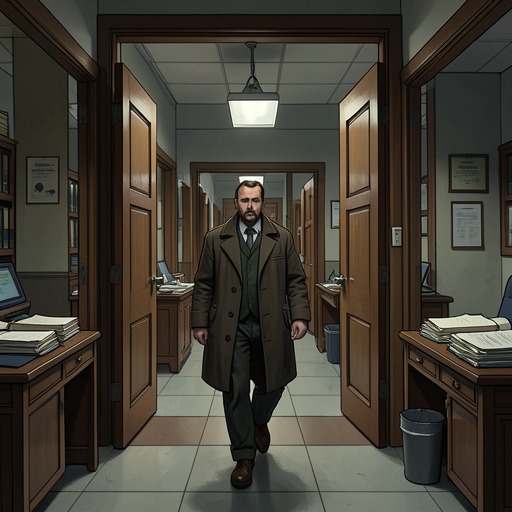
Koshkarev’s estate is presented as a landscape under relentless construction and reorganization. Chichikov reaches it after a half-hour drive to find building and repair work underway throughout the village, with alleys choked by lime, bricks, and timber. Some huts have been converted into offices bearing grand gilt-lettered signs, including one for the Estate Works Committee. The signs make the estate’s administrative ambitions physically visible: ordinary village buildings have been enlisted into a growing institutional apparatus.
The Committee is not shown acting independently or making a decision. Instead, it is one named link in a larger route that Koshkarev recites from behind his desk. The petition must pass first through the Office for the Reception of Reports and Returns, then return to him, then go to the Estate Works Committee for revision, before proceeding to the Administrator and Secretary. The chain assigns each office a place, but the passage offers no practical reason why a request must travel this circuit.
Chichikov’s Petition
Chichikov comes to the Colonel seeking a few souls who are, as he puts it, dead. Koshkarev initially translates the request into the language of administration, asking whether Chichikov means to present a Statement of Plea. When Chichikov agrees, the Colonel directs him to write it down so it can be forwarded into the office sequence, including the Estate Works Committee.
Chichikov objects that this will take too much time and tries to state the matter plainly: he wants a few dead souls. The response is not to simplify the process or address the request directly. Koshkarev instead instructs him to put the phrase so to speak, dead into the Statement of Plea. Even the plainest description is thus absorbed into the required form, where wording itself becomes another administrative requirement.
Procedural Satire
The Committee’s significance lies in the gap between the directness of Chichikov’s purpose and the elaborate itinerary imposed on it. The estate’s offices promise organization, revision, and onward transmission, but in this encounter the sequence chiefly delays an answer. Authority is dispersed across desks and titles; the request can be passed along without any one official confronting what it means.
The episode also links the Committee’s visible presence in the village to its function in the paperwork. Among heaps of building materials and offices with imposing names, it belongs to a system that advertises planned improvement. Yet when Chichikov asks for a transaction, the system converts it into a document to be routed and revised. The Committee is therefore less a portrait of a fully developed institution than a pointed part of the novel’s comic depiction of bureaucracy: procedure proliferates, while the real business remains waiting.